Sunday, December 02, 2018

First steps for the new design

Today I modified the previous drawings for the 14 guide boat frames (2 each of 7 different shapes) and made an estimate of how much lumber will be required.  I want the frames to be 1/2" thick and will need some 1" to 2" wide pieces to bond and trim into the required shapes.  I already have a 12' x 7 1/4" x 1/2" beautiful piece for the plank keel which required some careful trimming to remove a slight curve.  My full-size drawings of the frames, keel ends, and plank keel were made on rosin paper.  I like that the rosin paper comes in three-foot wide rolls and is fairly strong and stiff.  I think I may want something even stiffer when I make patterns for the planking.  I just discovered a new candidate for patterns- Ram Board, it is stiffer, smoother, and has a lighter color (so pencil lines show up better), but it is also more expensive.

Once I get the frames almost done, I will be looking for material for the ends and for the battens at chines and sheer.  Sheathing decision will wait; I can always use thin plywood, but would like to incorporate some solid but thin planking.  I just need to see what will take the required curvatures.  With developable hull surfaces, many options exist for sheathing it.

Below is a print out of the essential dimensions for a slightly revised guide boat.  The previous published dimensions will produce a good result with a few less details, but I made a small revision, creating one more chine, to create a smoother, more refined, visual shape.

The blemish on the photo is due to an internal "floater" in the camera.  The numbers are still legible, but I may be looking for a new camera.

Below is a drawing of several stations in the series of cross-sectional frames for the new hull shape.  As you can see, adding an additional chine allows a more rounded hull shape.


One of the advantages of this design is the low seating position it provides; occupants are seated very close to the level of the 4" waterline.  This provides great ultimate stability.  The level of the oarlocks has to be coordinated with the level of seating; thus, the low seating position also facilitates less required freeboard and a lighter hull .  I have started cutting out pieces for the future frames but won't post an pictures until things start being joined together.

Sunday, October 14, 2018

The improved guide boat.

Sorry for the lack of recent entries on this blog,but instead of building boats, we have been planning and traveling on vacations.  (Those trips, if interested, are documented at wgrabow.blogspot.com)  But I still have the "itch" to build a boat.  I completed plans for a new powerboat, but have no justifiable reason to exchange a new boat for the one we already have.... and a new build is expensive to fit out.  I have always liked the simple, continuous curvature of the faux guideboat I built almost twenty years ago.  I built it in a basement using hand tools.  The cost was low, and it has performed well.  However, every time I design and build a boat, I keep evaluating how it could be improved.  Thus, recently I dug out the plans for my previous guideboat and altered the plans to include improvements based on experience.


The previous hull was designed for maximum portability; light and compact.  See my previous entry "Guideboat pictures" to get an idea of the hull shape.  One person can manage cartop loading of the hull, but two are obviously more convenient.  It is not the weight, but the size that is awkward.  On the new design I added 6" length, 3.2 " width, and 1.8" in depth.  I changed projections for this developable design to reduce localized curvature (making it easier to sheath) and reduced the number of frames (spacing at 12" instead of the previous 9").  The hull can easily be built with increased length if desired by re-spacing the frames and adjusting the stem and keel profiles (or adding a parallel segment midships using the X=90" offsets), but 15' was chosen as a convenient length.  All dimensions are mathematically exact forming perfectly fair curves.  Dimensions are for a lines plan, to the inside of planking; add about 1" to width and 2-3" to length for the finished boat.

I used 4mm ply for sheathing on the previous hull which has functioned okay but seemed kind of flimsy when building, hence the 9" spacing of frames.  I will look for better plywood or solid wood sheathing for the next build.  The only real area of difficulty will be to sheath the pronounced curvature at the keel ends of the hull.  The plank keel is sized for use of easily obtainable nominal 1" x 8" lumber. Final overall dimensions will be about 15' 2" by 44" with amidship depth of 14" and a height of 23" at the ends.

At the 4" waterline, the hull is only about 30" wide which makes for an easily-driven hull.  Although tippy when you first get in, the low seating position and flare of the sides creates impressive ultimate stability.  That flare and the fine ends make for a dry and buoyant ride in waves.  The straight keel causes it to track well, and counterbalanced 8' oars provide good leverage for maneuvering.  These are all qualities inherited from the original guide boats.  The above-waterline beam I have added creates a more efficient rowing arrangement. 

I intend this to be very much a spare time project; so the start will not be immediate and progress will be slow.  I'll post more photos when I get time.  A typed, complete compilation of dimensions is posted below to aid others to build a similar boat if interested.  The dimensions are listed for only 1/2 of the hull length since both ends are symmetrical.  X= length from stem; Y= beam from center line; Z= height from keel base.


While on vacation, I had time to think about this project and decided on an additional "improvement".  By creating just one more chine, the cross section shape of the hull becomes more smoothly-rounded to the point where you can describe it as a true planked guide boat and not just a plywood semi-replica.  Each plank is roughly 3" wide.  Just home from our trip, I will be busy for the next week or so, but, as an addictive hobby, I will be providing more detail in few days.  Eager to get started.


Saturday, July 29, 2017

Getting ready to build

I have been making full-size patterns for a new boat.  The appropriate name would be "Design Nine".  You could call it lofting, but to me it is just a matter of plotting coordinates and connecting the dots.  The design is the same as the model shown in the previous post.  The only change has been to increase the deadrise angle to 14 degrees.  Full size patterns allow me to hone in on internal details, such as the exact construction of each frame.  I have in mind a new hull sheathing approach using more solid wood planking and less plywood which I would like to try.  My current boat performs well, and we have been doing a lot of traveling, so progress on a "next boat" will be slow.  I want to take more time on each piece rather than pushing to put everything together.  Building a hull is relatively inexpensive; when you add a motor, trailer, electrical; control system, upholstery and canvas, then you have a real investment.

This project is on indefinite hold while I pursue a simpler row boat design.

Wednesday, September 14, 2016

Completed new design model

Using paint and varnish cans that were already on hand, I have somewhat completed my hull model.  As I would on a full-size hull, I used a laser to produce the waterline boot stripe location. 

Friday, August 26, 2016

New Design Model, Part II

With an outboard engine, all the power and 300+ pounds of weight rest on the engine support; thus, that area needs to be very strong.  The engine support itself should be 2" thick; weakness can easily result if that thick, solid plywood support isn't adequately integrated to distribute its stresses to the surrounding structure.  My solution has been to recess the engine support into the stern of the boat.  In this way it is linked to the last three frames of the boat, to the keel, and hull sheathing.  With a fiberglass-wrapped, bonded hull structure, forces are dispersed into the entire hull structure.  The hull extensions behind the transom provide buoyancy for the weight of the engine, act as trim tabs, and aesthetically help blend the size of the engine into the overall boat shape.
A splash well has been included in the support design.  This allows the engine to be raised and tilted forward while allowing a rear deck and splash protection for the cockpit.  The engine support is angled at 14 degrees, the splash well bottom is angled to drain to the rear, and the well sides flare from bottom to top, providing more space for the engine itself than the lower unit.  None of this is "cut to fit"; with the hull being designed mathematically, all dimensions can be pre-cut very exactly.  The angles in this structure actually make it easier to put together; even without adhesive, the pieces are wedged together in a tight fit.

I have had time this weekend to fully sheath the model (my wife is out of town), and I am very satisfied with the result.  I'll post some photos; what do you think?

Wednesday, August 24, 2016

Creating a Model of a New Design

Boat design has been on hold.  After getting back from our trip to northern Europe, I cleaned, sanded, wiped-down and re-varnished the topsides on my current boat.  The boat needed to look nice for a boat show at Grand Lake, Colorado.  Following that, we went water skiing at Lake Granby (8500' altitude).  We had three adults and a dog (and picnic lunch) in my 18' boat and were pulling a slalom water skier all with the 75 hp. Evinrude.  I'd like to think that it takes an efficient setup to handle such a load.
This photo was taken at Turquoise Lake, Colorado, located near the continental divide at almost 10,000 feet altitude.  The boat performed well but with reduced power.


Now I am back to creating a 3' wooden model (1/6.25 scale) of what could be my 9th boat design, if I can justify building it full size.  Functionally, it may not be much different than my current boat, but I hope to provide some pictures to demonstrate a more curvaceous, attractive hull shape.  The building steps for a model are similar to full size building, and I will describe the steps as if it were a full-size build. 

The first step in building is always to build the frames and curved anterior keel section.  This is important as it will form the skeleton of the boat.  Dimensions must be accurate, and joints need gussets to be strong.  For the model, I made the frames extra beefy, cut intact out of plywood to insure strength and accuracy.  I draw a pattern for each frame.  The design of frames must anticipate everything that comes afterwards because the frames help support the deck, seats, fuel tank, battery, shelves, steering... all the details that follow.  Instead of hard oak, I prefer to use softer, larger dimension lumber, such as Douglas Fir, because I want larger surface area joints for adhesive bonding instead of screws.  Bonding distributes stresses more evenly.  Each frame should be marked with the mid-line and a common reference horizontal line to be used for frame alignment.  The pile of resulting frames still looks like an odd pile of lumber, not giving much hint of the hull to come.


A rigid strongback form is created to position all the frames in sequence and alignment.  This is where you first get a glimpse of the boat's shape.  The strongback needs to aid in holding each frame in horizontal, vertical and longitudinal alignment.  The frames can be accurately aligned using a laser beam; eyeballing or using a tight string can work also.  A clever design addition might be to make the strongback so that it can be tilted port and starboard to improve access to various portions of the hull during building.  Then the keel, chine, and sheer are added.  Other longitudinal elements are added: keelson, cockpit edging, foredeck plank, etc. to add more rigidity and further define the hull shape until the strongback is no longer needed.
 
With all the major elements in place, the hull next needs to be faired so that all parts flow together as a foundation for a smooth hull sheathing.  Using a developable design allows visualization of the "ruling lines" which radiate from a conic projection or run parallel in a cylindrical projection.  Laying a straight edge along these ruling lines makes fairing easy.  Once the fairing is completed, patterns for the hull sheathing need to be made.  Stiff paper or thin (and cheap) plywood work well.  Rosin paper, used with flooring underlayment, has worked well for me.  The staging of the outer layer of planking can easily be drawn out on these patterns.  I was pleased to see that the hull patterns for the bottom and topsides are somewhat linear, rather than banana or "S" shaped as in some designs.

Resulting patterns are then laid out on plywood for the inner sheathing.  For this scale model, 1/8" plywood was used and bent around the frames smoothly; 6 mm. marine ply should adapt easily to the full-size hull without excessive clamping pressure.   When cutting out the plywood from the pattern, I leave a little extra to allow for inaccuracy.  Then I soak the plywood in a basin of water for several hours to make it more flexible; clamp it in place on the framework until it dries; mark and trim the excess; and finally the plywood is ready for final bonding.  On a full size hull, the plywood is in two sections for ease of handling which is scarfed together in place on the hull.
  The design includes a chine flat several inches wide on the full-size hull which you can see in this frontal view (in case you are wondering why the discontinuity at the chine).

Saturday, July 09, 2016

Beautiful boats of Scandinavia


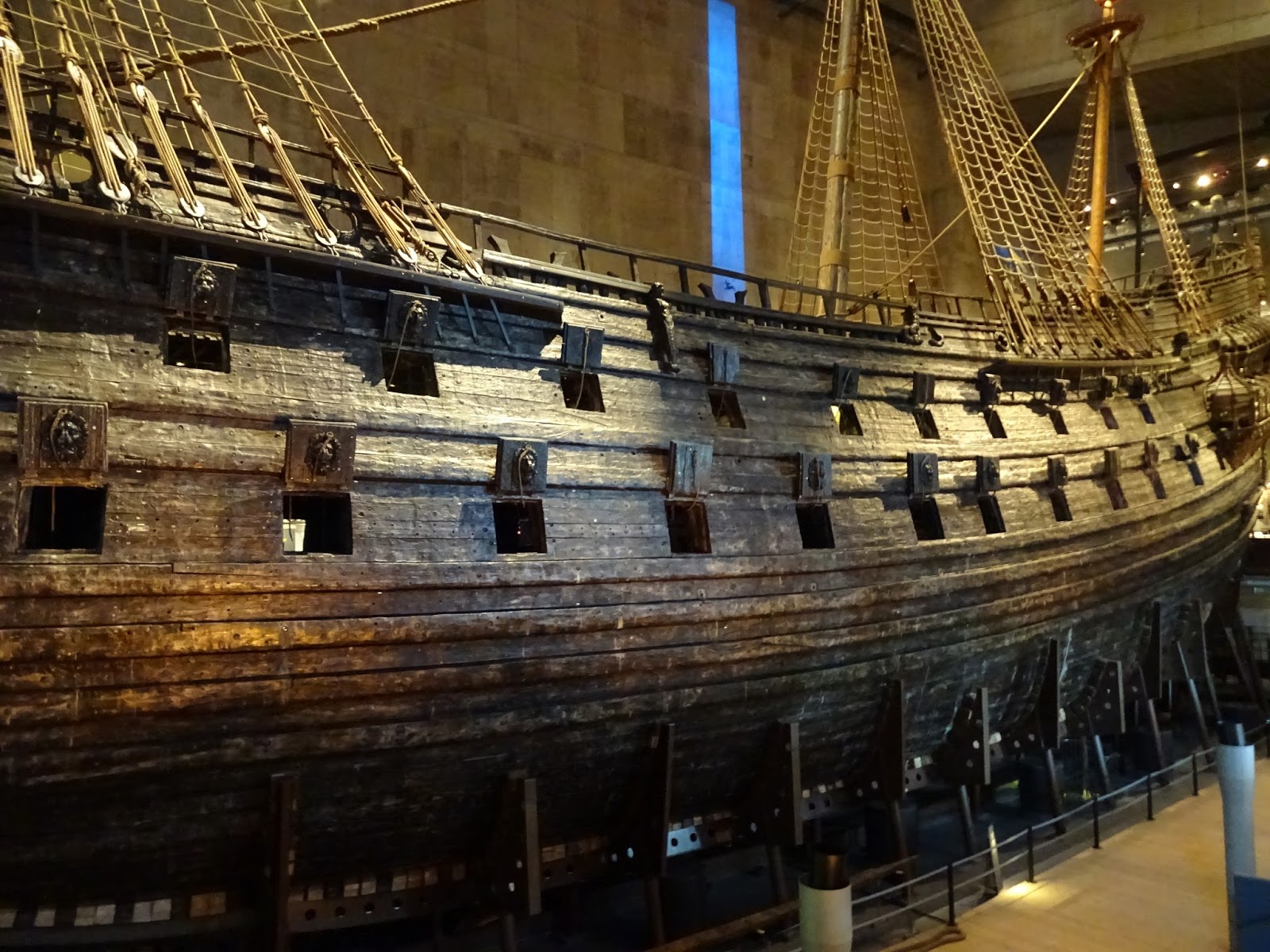
1)  Oslo, Norway,  A Viking Longship recovered from a grave site.  2) Bergen, Norway, Square-rigger for tourist trips.  3)  Sigtuna, Sweden,  Twin 36' sailboats for father and son.  4) Stockholm, Sweden,  The Vasa, the King's pride, sunk in 1628 at launching.  5) Stockholm, Sweden,  A beautiful wooden cruiser locking through.  6) Helsinki, Finland, a traditional schooner in the Baltic. 7) Stockholm harbor, Hyundai race boat. 8) Helsinki, Finland, a harbor passenger ferry. 9) Helsinki harbor, a cute little wooden runabout,  10) Klaipeda, Lithuania, a square-rigged restaurant.

Scandinavia has such beautiful boating locations; on a warm day, the boats are everywhere.

Friday, October 30, 2015

Vietnam Memories


A coworker recently learned that I am a Vietnam vet and asked me for information.  That started me thinking about long past events, and I decided to write down one of my most memorable experiences, a trip out of the war zone to Japan.  The story is off topic; I'll post some Vietnam boat pictures to give the story context.  Above, top to bottom: 1. Wayne, on watch on the bridge of the USS Askari.  2. A patrol boat of the S. Vietnamese navy.  3. The smoke of battle on the horizon on the Mekong.  4. Heavily armored landing craft used in close range patrols/combat in canals off the Mekong River. 5. A peaceful sunrise on the Mekong.  6. Downtown VungTau.  

September, 1966, I entered active duty with the US Navy.  After attending basic navigation school, I reported aboard the USS Askari, ARL-30, and was immediately assigned to help load armor plate and other supplies for our mission in Vietnam.  We left San Francisco in early December, stopping in Hawaii and the Philippines along the way, toward our new homeport of VungTau, Vietnam.  Most of 1967 was spent in the Mekong Delta.  I then returned to Vietnam aboard the USS Preston, DD 795, during the summer of 1968.  It was an important point in my life when I was on my own, deciding what was important and who I wanted to be.  No one cared whether hours were spent in a library or a bar; each person chose their own path.  It made for interesting observations and experiences.

When you were stationed “in country” in the combat zone for an extended period you would eventually qualify for “R&R”, rest and relaxation outside Vietnam. A friend, Carl Nixon, and I both qualified for R&R in June ’67 and both chose Japan as our destination. You were given permissive orders for the period.  “Permissive” meant that you were to find your own way from our ship upriver on the Mekong to Saigon to catch a flight and then find your way back upon return.  We got a ride on a boat downriver to the coastal town of VungTau.  As soon as we arrived, we made ourselves scarce until the scheduled flight to Saigon had departed; then we reported in at the airfield.  That gave us an extra day on our own.  At VungTau, we often would walk some distance to an off-limits beach in a rocky cove served by a single café.  There we could eat lunch and play in the waves which were sometimes big enough for body surfing.  Later, we had dinner and a few drinks in town and, in the process, were joined by another Navy man who was headed to Saigon.  With curfew time approaching, the three of us visited a local hotel to get a room for the night.  The entry to the hotel featured a line of young women waiting along the corridor.  Carl and I politely declined companionship for the evening, but the other fellow bought dinner for “his girl” and she spent the night with him.

The next day we took a twin rotor Chinook helicopter to Saigon; it felt like a flying bus. The military had leased an entire hotel with a barracks-type configuration for transient personnel in Saigon.  We didn’t wander far from the hotel that day, saving our funds until we reached Japan. We were anxious to get started and happily boarded a leased aircraft the next morning.  Arriving at Tachikawa AFB near Tokyo, we were given barracks-type beds & lockers.  This would be home base.  We relaxed and took a swim in the base pool.  Carl and I had lost our fellow Navy man, but picked up a crazy Marine on R&R.  Why do I say crazy?  This man had been in Vietnam for several years on back-to-back tours in the region of the North Vietnam border.  Every time his tour of duty was up, he would volunteer to stay longer.  Why would he do this?  Because soldiers don’t fight for their country; they fight for their buddies.  If he went home to the US, in his mind he would be abandoning his “band of brothers”.  At this point his unit had sent him on R&R, and then he was mandatorily being sent back to the States.  They would allow no more extensions, and we could sense why.  He spoke casually about killing the enemy, had done it multiple times, and the enemy was anyone who would harm a US Marine.  It was questionable to us how he would re-adapt to civilian life.

Our Marine wanted to rent a taxi and go to Yokohama (20 miles away) to drink Black Russians at a bar he knew of.  Money meant nothing to him.  We decided to go with him and show him how to use the train system, saving considerable funds.  We found the bar, and drank a few Black Russians, but not enough to keep us from finding our way back.

The next day Carl and I set out again on a train to explore the area.  While on the train (think metro commuter line), I noticed a man reading a newspaper section which had a picture of a person water skiing on the back cover.  We asked where the picture was taken, and, although communication was limited, we were able to ascertain that the water skiing was at Hayama Beach, on the ocean southwest of Tokyo.  Looking at the train schedule, we realized that we could make the last train to Hayama that night.  Arriving at Hayama Beach well after dark, we walked down to the beach and discovered a party for college students was taking place.  We were immediately invited to join the party with the incentive, “We have more beer than we can drink.”  They were very friendly and spoke fluent English. We learned that water skiing was offered in late morning sessions and that a college music festival was taking place for the next few days. A little before midnight we rented a bamboo shack on the beach to sleep in.  Being in the Navy on a regular watch schedule I had developed an internal clock and was able to awaken at an early hour to get us on our way.  We needed to get up early to take the train back to our home base to clean up and get bathing suits and fresh clothes.

We arrived back in time to sign up for water skiing. This consisted of all participants lining up for mandatory exercises; then being transferred by boat to a covered platform moored in the bay.  The ski boat would come by the platform, each time picking up a new participant for a short period of skiing.  Water skiing was apparently a very new sport in Japan.  I watched people struggle to get up and then wobble around for a few laps before collapsing in the water.  This was the ocean, and waves were present, so their difficulty was understandable. Growing up in Nebraska, I had been skiing for 5-6 years using our family boat.  When it was my turn to ski, I quickly kicked off one ski to slalom and was able to perform enough tricks that a photographer was called out to the platform to take pictures of the action.  He had questions for my friend, Carl. The photographer couldn’t speak English, and Carl knew no Japanese, but they discovered that they both were fluent enough in Spanish to discuss water skiing.

Carl was an interesting guy.  Out of high school, he was accepted and enrolled at the US Naval Academy.  After a short time at the Academy, he decided he didn’t like it and requested release. His request was refused until he contacted his Alabama Senator, who was on the Armed Forces Defense committee. He then quickly got his release from the Academy, but it wasn’t a release from military commitment. He was ordered on enlisted duty on our ship, the USS Askari, in Vietnam.  After release from active duty, he eventually moved to Morelia, Mexico, where he graduated from medical school and became a primary care physician in rural Mexico.

After skiing we discovered that a dance would be held that night.  Carl and I went to a local communal bath house to freshen up.  Do you take a shower before stepping into the hot pool or afterwards? We may have done both. That evening we went to the dance. The music was almost exclusively familiar American rock & roll songs.  As we walked in, all the girls were in clusters along the far wall, and the boys were along the near wall to our left.  The dance floor was uncrowded. Adults were at tables toward the rear of the room to our right. We were the only Caucasians present. What do you do in such a situation?  If you are on R&R from Vietnam, you ask a girl to dance.

My attention was drawn to a girl standing on the edge of a group (pretty, relaxed, not engaged in the group chatter), and I approached her with a request for a dance.  After several dances she, Tamea, asked me to meet some of her relatives, who were seated in a booth toward the back of the room.  I learned that Tamea’s extended family rented one floor of the Hayama Beach Hotel each summer for several weeks.  Tamea was a student at Tokyo University.  Later that evening, Tamea and one of her female friends took Carl and me for a ride to show us the area.  We sat in back with a white-gloved chauffeur driving our dark limousine-type car and drove to a lookout point for a view of the surrounding bay area illuminated by thousands of lights along the shore.  After such hospitality, Carl and I requested that we treat the girls (okay, young women) to dinner the following day.

The next day we spent the afternoon listening to the music festival and talking with Tamea and her friend; one subject was explaining the lyrics and their context for American songs.  That evening we had reservations for dinner in a private room at the hotel.  As an E-4 in Vietnam, I was paid maybe $300 per month, but the exchange rate was 360 yen to the dollar, and we were on vacation.  We wanted to show our appreciation.  However, toward the end of the dinner, Tamea’s brother walked into the room.  Carl and I knew that was a 'bad' sign.  Sure enough, they would not let us pay for dinner!  Look, we are enlisted US warmongers from Vietnam!  Why are you treating us so nice?

I had agreed to shop for some speakers for a friend’s stereo system back on the ship in Vietnam before we went home (to Askari).  The week ended quickly.  Before leaving, I got Tamea’s address and learned that her father’s name was Dodan Kuruma. He was President of the Tokyo Buddhist Federation.  They lived in a suburb of Tokyo (Toshima-ku).  Her father had traveled extensively, to the US and Europe as well as throughout Asia, as a part of his responsibilities.

Tamea and I exchanged several letters during the next four months.  When I was notified of the November end date of my Vietnam duty and realized that I would be passing through Japan on my way to the States, I let her know, and she invited me to visit at their home in Tokyo.  Carl Nixon was given the same return date; we would be flying back together.  Again, we were routed to VungTau, Saigon, and on to Tachikawa AFB, where we would lay over for a few days awaiting our flight to Travis AFB, California.

As soon as we arrived at Tachikawa, Carl and I headed for a train to Tokyo.  Another shipmate, Steven Quade, asked to be included.  Tamea had met Carl, but I was hesitant to impose on the Kuruma family with three of us.  Quade was from the south side of Chicago (“the baddest part of town” according to Jim Croce’s song).  He didn’t have college aspirations like Carl or me, but he was a fairly polite and decent guy so we couldn’t refuse.  We had the commuter train directions figured out, and the three of us had little trouble making train transfers to arrive in Toshima-ku.

Stepping out on the street of this busy neighborhood, we wandered for a while before giving up on finding Tamea’s home.  We enlisted the aid of the local police precinct station.  A helpful policeman escorted us to the Kuruma home.  No wonder we couldn’t recognize the home!  OMG!  It wasn’t a house; it was a compound encompassing an entire (small) city block.  A tall, black, wrought-iron fence enclosed the entire block.  The entry gates were closed; behind that were trees, bushes, a garden, and the home.  The policeman was able to rouse one of the house staff to open the gate and notify the family of our arrival.
They quickly invited us into their home, more family members arrived, and we enjoyed a warm welcome.  We were invited to stay for dinner.  The dinner table was only about one foot above the floor, but we discovered that the tablecloth disguised a foot well built into the floor under the table.  We tried our best to use chopsticks and be polite guests, but I am sure we transgressed some unfamiliar Japanese custom.  They offered us the option of forks to use and were forgiving of any shortcomings.  After dinner, various conversations sprang up around the table, lubricated by ample servings of wine and sake.  When we said our good-byes for the evening, Tamea’s brother escorted us to the train station to ensure that the sake’s influence didn’t mislead us.  We were invited back the next day.

Upon arrival the following morning we were introduced to Tamea’s older sister, Masayo. Wow! Tamea was a very pretty young woman, but her older (and taller) sister, Masayo, would have been appropriate on a magazine cover.  They offered to show us downtown Tokyo.  We took a smaller vehicle, Masayo (driving) and Tamea in the front seat, and us three sailors in back.  It was amusing to watch these two gorgeous women maneuver their way through heavy traffic.  With the car windows open, they would smile and wave out the window and the nearby cars would move aside to let them pass.

We parked in front of the Imperial Palace and walked the area, peering through the surrounding fence at the extensive landscaped gardens.  Tamea’s father, Dodan, met us at Chinzanso restaurant for lunch.  This is an internationally known eatery where we were served, outdoors in a garden, by a chef preparing our meals at our table.  Later we went to a playground/park with adult-sized swings, slides, and such items and walked, talked, and played on the equipment.  Tamea and I went down the slide together (my arms around her).  For dinner, we rode an elevator to the top of a skyscraper in downtown Tokyo to the Suehiro restaurant.  The entire restaurant rotates as you dine so that you enjoy a 360-degree skyline.  Another famous eatery: no, we were not allowed to pay for ANYthing.

The following day, Carl, Steven, and I boarded our non-stop flight to Travis AFB, near Sacramento.  I passed through Tachikawa again in September 1968, coming home from my second tour in Vietnam, but was only there for a few hours.   I continued corresponding periodically with Tamea for about 1-1 ½ years after that until I mentioned in a letter that I had a girlfriend.  Carl and I kept in contact until he graduated from medical school.  I always considered Tamea as a “pen pal”.  She was obviously very attractive, educated, and congenial.  But there was a huge economic, cultural and geographic separation to consider, and I was only a college student financially on my own.

I have never forgotten my visits to Japan because what we experienced was so exceptional.  It seems like a dream with events bigger than life.  What motivated this wealthy, high class family from a vastly different culture to treat us with such openness and generosity?  Is this the Buddhist influence?  Carl and I were junior enlisted sailors from a war zone; nothing notable about us.  Wouldn’t most people have brushed us aside?  How did this all happen?

Sunday, October 18, 2015

Along the Adriatic Coast

                                                     The complete tan, near Rovinj

To end the summer, we spent most of September in Europe with our main destination being Croatia. The Adriatic, Istrian Peninsula, Dalmatian coast must represent one of the most ideal yachting areas on earth.  Of course we couldn't bring our boat, but we did enjoy a day cruise in the Porec-Rovinj area of Istria, a stay on the island of Hvar, and ferry boat rides across the Bay of Kotor.  The weather was perfect, the waves were moderate, and the breeze was consistent for the sailors.  Anchored off the city of Split was the beautiful and unique yacht "A", 394 feet long with the outline of a modernistic submarine.  It is reportedly owned by a Russian billionaire who is now building a larger yacht.  For me, ogling the beautiful yachts, in the harbors along the coast, was a significant attraction.  Hvar and Dubrovnik are especially beautiful.  Put the area on your vacation wish list. 

Sunday, August 09, 2015

Grand Tetons National Park boating

This summer we have been traveling, towing our boat to new locations.  We started at Holter Reservoir, near Helena, Montana, then on to McDonald Lake in Glacier National Park, and, from there, onward to Lake Coeur d'Alene, Idaho.  With the concern about invasive aquatic species, the boat has been inspected numerous times as we traveled from lake to lake.  In Wyoming, Montana, and Glacier N.P. the inspections were free.  In Idaho we were charged for a state sticker but received no inspection.  Then we traveled to Grand Tetons National Park.  There, we first had a park entry fee, then a boat inspection, then an aquatic invasive species sticker $30 payment, a boat entry fee payment ($40 season's pass only), then a $35 per day slip fee.  We then discovered that another boat was already tied up in our assigned slip.  It was almost sundown before we were able to launch and tie up in our assigned slip.  We were wondering if all the cost and hassle was worth it.  But, as we motored out onto the lake next morning, all our concerns faded.  The Grand Tetons have to be one of the most scenic mountain ranges on earth.  Steep, jagged peaks still with visible snow fields in mid-summer.  The mountains end right at the lake's edge; the shores are covered in undisturbed dense forest.  As we went out onto the main lake, I recorded a reverse compass bearing of the entrance to the cove where our dock was so that we could find our way back to it.  Jackson Lake is about 15 miles long by 7 miles wide with over a dozen islands and located at a high altitude of about 6800'.  From a distance, the shoreline blends into continuous forest.


We spent the next three days exploring the lake (as well as hiking).  The water is clear, cold, and deep (almost 450 feet).  Few other boats were encountered.  We went water skiing briefly (no wet suit).  The Tetons, especially Mt. Moran, kept attracting us like moths-to-a-candle with its high, rugged prominence and partially snow (glacier?) clad slopes.  The peaks were so picture-perfect they seemed like something computer-generated out of a movie.  The weather was cool and calm which meant very few waves.

We met my brother and his wife at the lake.  They have a 27' Sea Ray cruiser, twin engine, 430 hp, so we cruised the lake together, stopping in quiet coves for lunch.  I had mounted a 13" pitch propeller on my boat which provided extremely quick acceleration and a top speed of 33-34 mph.  We had a full tank of gas (18 gallons) because we spent hours exploring away from any harbor.  My brother, Jay, commented that he had never skied behind a boat which pulled him out of the water so quickly (and he has been skiing for 50+ years).  I could have easily mounted a 15" pitch prop which would have provided more speed.  My wife, Dawn, also enjoyed the boat handling, such as making high-speed circles, banking into the turns and creating a large wake.  It rained several times, mainly at night, but our full canvas enclosure kept the boat interior completely dry.


At this point, I am completely satisfied with my boat's performance.  The secret to success in this case is the strong but light-weight construction of the boat.  Modern wood/epoxy/glass construction provides a water-tight, monocoque, composite structure which is significantly lighter than normal fiberglass.  I should add that the boat tows on its trailer so easily that you can almost forget that it is there.  We towed on the highway at 80 mph or better when allowed.  Our SUV still got decent fuel efficiency, 16-18 mpg.  One thing needs to be addressed: I originally wanted to paint the topsides but was encouraged to finish it clear to show the wood grain.  Now the "clear" finish is becoming slightly opaque and uneven in color.  Before next boating season, I hope to sand and paint the topsides.  A black color, to match the deck edge, would be the most obvious choice, but I would prefer a lighter color to not absorb so much sunlight.

The link below is to a brief video showing the beautiful scenery surrounding Jackson Lake with our runabout gliding across its surface.

https://youtu.be/X1m7WiJS7S8


Wednesday, April 22, 2015

Modified "next boat" design

After re-considering the boat lines plan I posted a few months ago, I decided it could be improved.  The aft portion seemed too dominant, so I added more taper to the deck and topsides, and gave the transom more of a forward slant.  That aft section is now proportionally smaller.  My goal in developable designs has been always to show that a design that can be sheathed in plywood doesn't have to look "boxy", and I think that has been achieved.  Of course, a developable design can also be sheathed by almost any other technique or material.  There are no sharp curves which would require extra thin sheathing materials; 6mm ply will bend to

any of these curves.

An outboard engine of 60-90 hp should give 30-40 mph at the altitude here (6000') and somewhat faster speeds near sea level.  I have wondered about installing an inboard engine, revising the cockpit, and increasing the deadrise to 14 degrees (due to an anticipated greater displacement).  An inboard would have that authentic runabout aura; the deep rumbling exhaust; the weight and power to knife through waves, but I can't forget the many advantages of an outboard.

We will be busy this summer on some significant boating trips: the Grand Tetons in Wyoming, Glacier National Park in Montana, and Coeur dAlene, Idaho.  Our current boat is well-suited for the trip.  The ample freeboard and raised foredeck provide weather protection.  A newer boat is only a dream for now; however, I hope to build a scaled model this winter.

Because the design is created mathematically (geometry, algebra, trigonometry), the design is initially a table of offsets for a full-size hull. To make a model, the dimensions need to be scaled down and then plotted on paper.  Engineering paper makes the task easier for a model.  Full-size patterns require much larger sheets of strong, stiff paper (rosin paper) and careful plotting.

Wednesday, February 11, 2015

Sail design

Long ago, in 1983, I was building a two-masted 20' sharpie.  Naturally, it was a custom design and would require custom sails.  In order to save money, I would sew my own sails.  Sailcloth was ordered from the Sailrite company which is still in business.  At that time it was headed by Jim Grant (and may still be) who put out a quarterly newsletter.  As a customer, I received a newsletter which included an article on "broadseaming", a method of varying the width of seam overlaps in the fabric panels of a sail so as to control the shape, specifically the draft, of a sail.  Broadseaming was considered to be an art and somewhat of a mystery (at least in the published literature).  Just as plywood hull shapes can be described mathematically, I thought that sails made from stabilized fabric panels could be similarly described.  I wrote a letter to Sailrite outlining such an idea.  Later, upon receiving the July 1984 Sailrite newsletter, I discovered that Jim Grant had made my letter into an article titled, "The Mathematics of Sail Design".  Although CAD technology has progressed greatly since 1983, that article is included here because a recent internet discussion suggested that even now little has be made public.


Jim Grant overstated the difficulty of the mathematics required for these computations.  An inexpensive pocket scientific calculator provided necessary results for me, and the described method was used to design the sails for that 20' sharpie.  A photo of the sharpie is included in which you can see the shape of the sail draft by looking at the curved shadow that the straight sail boom makes on the sail surface.  The curvature appears to closely duplicate the cross-section shape of an airplane wing.
  I made one mistake in this sail design: the draft is too shallow.  Due to a lack of published data, I had to guess what the proper draft/chord ratio should be.  I guessed too shallow (it was about 7-8%); it should have been about 10-11%.  Although the boat handled okay, I have wondered how much more power the sails would have developed with a greater draft.

Sunday, December 21, 2014

Next Boat?

Should there always be a "next boat"?  Creating another boat design is always rewarding: changing a mental vision into something that is real; something you can see and touch.  The work of creating and building is a pleasurable challenge, but how many boats can one person use?  I only have space for one full-size boat.  To completely equip a new boat is far from cheap.  And there is no guarantee that the new boat will be better, only that it will be different.

With that in mind, I started on a new design.  The guiding idea was to create something with more curvature to be more visually interesting but maintain an uncomplicated build sequence.  A forward sloping bow profile with more lateral flare provides a more modern look and will also be easier to plank.  The raised foredeck of my previous build added complication to the build and would not blend well with the flared bow; thus, it was deleted.  The vertical stern on the previous build was helpful in providing internal volume for flotation foam, but it was esthetically bland.  The new hull would have a forward sloping stern.  The topsides avoid any slab-sided sense by continuously transitioning from significant flare forward to significant tumble-home aft.  In fact, tumble-home has been reduced to be more in harmony with the added beam forward.  Added beam means more usable cockpit space.

The result, if built full-size, would be a hull 18 1/2 feet long by 6 feet 3inches wide with a 12 1/2 degree deadrise for about the aft 1/2 length of the hull.  Of course, the hull surface is fully developable which simplifies construction and provides exact dimensions.

If you can't build the full-size boat, a model helps to visualize what has been designed and also really clarifies construction details.  Thus, I built a model at 1/6.25 scale (alternately expressed as 0.16 scale) which gives a model about three feet long.  I had enough scraps from previous projects to provide all the parts.  At this point I regret not spending more time creating a rigid strongback building form.  Some of the frames shifted as parts were bonded together resulting in a slight distortion in the model, but it still is accurate enough to serve its purpose.  And I was able to visualize


a much better strongback design to be used if the hull were ever built full size.  For now, the next boat is a dream.  Owner designed, home-built wooden boats are hard to sell.  I need more time to enjoy the boat I completed last spring, and a new boat would take about two years, spare time.  Anyone looking for a design to build?